De buena fuente
On the Provenance of a Kunstkammer Elephant: Animal Diplomacy and a Prop Artist in the Early nineteenth Century St. Petersburg
Sobre la procedencia de un elefante de la Kunstkammer: diplomacia animal y un artista de utilería a principios del siglo XIX en San Petersburgo

On the Provenance of a Kunstkammer Elephant: Animal Diplomacy and a Prop Artist in the Early nineteenth Century St. Petersburg
Prohistoria. Historia, políticas de la historia, núm. 42, 1-8, 2024
Consejo Nacional de Investigaciones Científicas y Técnicas (CONICET)
Recepción: 28 Mayo 2024
Aprobación: 21 Junio 2024
Publicación: 22 Diciembre 2024
Abstract: The museum of the Zoological Institute of the Russian Academy of Sciences in St. Petersburg exhibits a taxidermy piece and a skeleton of an Asian elephant (Elephas maximus Linnaeus, 1758), mounted in 1806-1807 for St. Petersburg Kunstkammer. The anatomical accuracy and the technique of this taxidermy piece are exceptional for the beginning of the nineteenth century yet the name of its creator has not been known. A careful study of archival documents survived in the Archives of the Academy of Sciences permitted us to reconstruct the identity of scientists and artists involved in the making: it was a prop artist and papier-mâché craftsman Сarl Thimpont (died 1829), while anatomist Piotr Zaslavsky (1764-1846) supervised the construction of the skeleton. Likely, they both consulted the drawings made by anatomist Petrus Camper in 1802. The elephant was a diplomatic gift from the emir of Bukhara to Catharine II. The animal arrived to St Petersburg by autumn of 1796, was kept in the menagerie of the Imperial Hunting Yard, and died in the April of 1806.
Keywords: Taxidermy, Elephant, St. Petersburg Kunstkammer, Early Nineteenth Century.
Resumen: El museo del Instituto Zoológico de la Academia de Ciencias de Rusia, en San Petersburgo, exhibe una pieza de taxidermia y un esqueleto de un elefante asiático (Elephas maximus Linnaeus, 1758), montados en 1806-1807 para la Kunstkammer de San Petersburgo. La precisión anatómica y la técnica de esta pieza de taxidermia son excepcionales para principios del siglo XIX, aún se desconoce el nombre de su creador. Un estudio cuidadoso de los documentos de archivo conservados en los Archivos de la Academia de Ciencias nos permitió reconstruir la identidad de los científicos y artistas involucrados en su creación: el artista de utilería y artesano de papel maché Сarl Thimpont (fallecido en 1829), mientras que el anatomista Piotr Zaslavsky (1764-1846) supervisó la construcción del esqueleto. Probablemente ambos consultaron los dibujos realizados por el anatomista Petrus Camper en 1802. El elefante fue un regalo diplomático del emir de Bukhara a Catalina II. El animal llegó a San Petersburgo en el otoño de 1796, fue mantenido en la colección de animales del Imperial Hunting Yard y murió en abril de 1806.
Palabras clave: Taxidermia, Elefante, Kunstkammer de San Petersburgo, Principios del siglo XIX.
On the Provenance of a Kunstkammer Elephant: Animal Diplomacy and a Prop Artist in the Early nineteenth Century St. Petersburg
The principles on which modern taxidermy is based (in English it is called modelled taxidermy while the Russian equivalent is “sculptural taxidermy”) became widespread relatively recently. Donna Haraway’s famous essay “Teddy Bear Patriarchy” discusses one of the founding fathers of this method, Carl Akeley (1864-1926) (Haraway, 1984). Mikhail Zaslavsky (1921-1993), who authored a few Russian books on taxidermy and was an eminent taxidermist himself, stated that modelled taxidermy developed in the late nineteenth and the early twentieth centuries (Zaslavskiy, 1979). Zaslavsky characterized the works of earlier masters unflatteringly, noting their lifeless appearance, stiff straight legs, barrel-shaped torsos, and the lack of musculoskeletal relief. However, in the same book, Zaslavsky talked about some exceptions. For example, he described the Asian elephant (Elephas maximus Linnaeus, 1758) made for the St. Petersburg Kunstkammer in 1806-1807 as “a magnificent example of taxidermic art”, which was made on a sculptural mannequin –“an achievement of the twentieth century taxidermy” (Zaslavskiy, 1979: 133)–. This elephant still decorates the exhibition halls of the Zoological Institute of the Russian Academy of Sciences, the heir to Kunstkammer’s zoological collections. The exceptionality of this mounted elephant was noted already in the 1830s, when zoological collections were moved from the Kunstkammer to a new building erected for the museums of the Academy of Sciences. The head of the Zoological Museum Johann Friedrich von Brandt spent considerable resources ensuring that this anatomically accurate animal would be moved to a new building without any harm, and in his correspondence on this matter he consistently emphasized the exhibit’s value.[1]
In the eighteenth and the early nineteenth century elephant was a still rare exhibit for natural history collections, and its size imposed additional restrictions. Not only was it problematic to obtain the body of an adult elephant, to process and mount the skin and skeleton, preserve the huge and thick skin from deformation and pests, but also the very premises to accommodate such large objects.[2] The luxury of having an adult elephant as an exhibit (mounted animal and / or skeleton) was usually available only to imperial museums, such as in Madrid or Paris.[3]Other collections could afford to acquire only smaller specimens –a skull or an embryo preserved in a jar– the latter was obtained by the royal collection in Stockholm from Seba (Cappellini et al 2014).
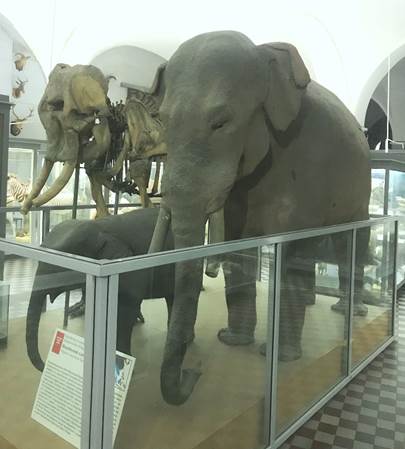
Figure 1.
The Asian elephant (mounted animal and his skeleton) in the Zoological Museum of the Zoological Institute, St Petersburg
Photoby author
Mikhail Zaslavsky regretted that the name of the master had been lost. Apparently, while working on his book, Zaslavsky used only published data and the documents kept at the Zoological Institute. Yet more information can be distilled from the records found in the Archives of the Russian Academy of Sciences.
Those documents show that on April 27, 1806, the Academy of Sciences received a message that an elephant had died at the Imperial Hunting Yard. The instructions approved by the emperor himself suggested that the Academy should immediately organize the skinning and the making of the taxidermy mount. The Academy’s administration entrusted the practical side of the matter to Ivan Alekseev (circa 1765-1837), a taxidermist and a housekeeper of the Kunstkammer, and theoretical supervision –to naturalists Nikolai Ozeretskovsky (1750-1827, the director of the Kunstkammer) and Pyotr Zagorsky (1764-1846, an anatomist)–.[4]
Zagorsky requested information about the elephant, and the officials of the Hunting Yard provided it. This elephant was sent to Catherine II in 1796 as a diplomatic gift from the emir of Bukhara.[5] The animal arrived with two mahouts who stayed in Russian service till the death of the elephant. Every day the elephant got four poods of the best hay (64 kg) and flatbreads, which were baked of one pood (16 kg) of the best wheat flour, while the mahouts made for the beast a “medicine” from a mixture of quite expensive spices with ghee, fish glue and honey.[6]In 1796, the elephant was 3 arshins and 3 vyershoks tall (2,26 m), and in 1806 it was 4 arshins and 1 vyershok tall (2,89 m).[7] The officials of the Hunting Yard described this elephant as a very intelligent and cautious animal, willingly following the orders of his Bukharian mahouts.[8] Every spring the elephant suffered from an “inflammation of the entrails” –probably it was musth, since the note mentions also a “secretion of a substance from his cheeks” (most likely “a substance” was temporin)–. At that time, the elephant behaved viciously, did not allow people to approach itself so that food was given to him from afar. During these periods, the animal could hardly eat; it mainly drank milk, 4 buckets a day, mixed with ghee. The elephant died on April 24, 1806, after “suffering from the same illness for about 40 days”.[9]
Other documents add some details to this information. 2027 rubles were allocated for the keeping of the elephant annually;[10] probably the sum did not cover the cost of hay, wheat and firewood, that were supplied directly from the crown domains. When the animal was indoors, it was chained by its hind leg - it was a common practice in menageries of the eighteenth and nineteenth centuries. Two Bukharian mahouts got rather decent salaries. After the death of the elephant, the mahouts got generous reward for their service and were sent back to their homeland.[11] Most of the documents describing the life of this and other elephants kept in St. Petersburg indicate that the Russian imperial court invested significant efforts in the well-being of this kind of live diplomatic gifts.
Since the task to mount an elephant for the Kunstkammer was obviously extraordinary, the emperor’s instruction allowed the Academy, if necessary, to invite an outside craftsman. Indeed, the maker was found outside the Academy and his craft was rather unusual: it was a prop artist and papier-mâché craftsman called Carl Thimpont. Usually, Thimpont worked for the Administration of the Imperial Theatres and for some architects.[12]
Thimpont finished mounting the elephant during the fall of the same year. The naturalists of the Academy were very pleased with his work. The next year Thimpont was invited to mount two brown bears (those taxidermy pieces were lost but we could assume they were made with the same method –the skin mounted on a sculpture–). He was also offered a permanent position at the Kunstkammer.[13] However, this did not happen: perhaps Thimpont was not happy about the salary.
The processing of large bones usually takes several months, so the skeleton mounting began only the following year. At the Academy’s meeting on March 11, 1807, Peter Zagorsky showed his preparatory drawings based on the images from the book published by Petrus Camper a few years earlier (Camper, 1802) to his colleagues. This approach was approved as a theoretical basis for skeleton mounting and soon the skeleton was installed next to the taxidermy piece[14]. Probably Thimpont used the drawings from the same Camper’s book.
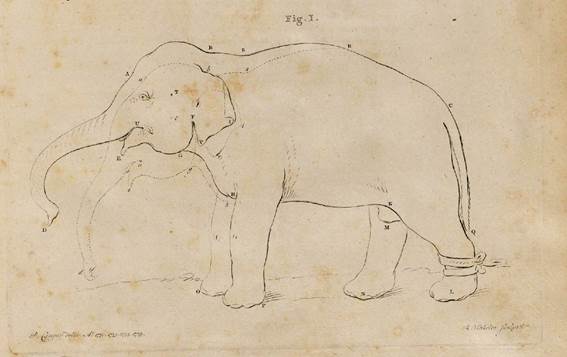
Figure 2
Drawings of an Asian elephant from the Petrus Camper’s book (1802)
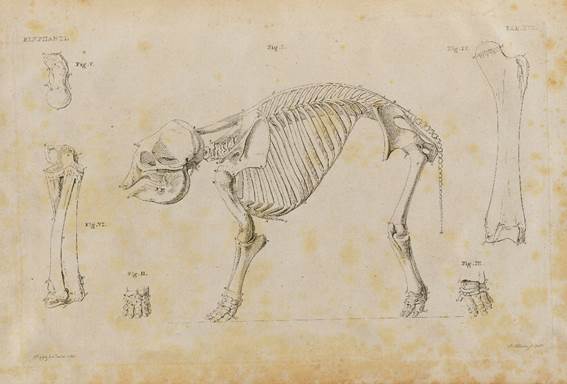
Figure 3
Drawings of an Asian elephant from the Petrus Camper’s book (1802)
The skeleton of the St Petersburg elephant as a museum exhibit was not that exceptional as Thimpont’s piece of craft but it played its role in the history of megafauna studies. It was of great use already in 1807-1808 when Wilhelm Gottlieb Tilesius had to assemble the mammoth skeleton brought by Mikhail Adams from the lower reaches of the Lena River. It was the first full mammoth skeleton obtained by naturalists. It is still exhibited in the museum near the elephant - the so-called Lena mammoth or Adams mammoth (Tilesio, 1815; Garutt, 1964).
Only one riddle remains: who exactly came up with the idea to invite a papier-mâché craftsman to mount an elephant? Was it the director of the Kunstkammer Nikolai Ozeretskovsky? Or Kunstkammer’s taxidermist Ivan Alekseev, who understood that mounting an elephant was a task beyond his capabilities? Or a member of Academy Alexander Sevastyanov, who in 1804 published the first text on taxidermy in Russian?[15] Or someone else? The idea, as Zaslavsky explained in 1979, was several decades ahead of its time. It could have become revolutionary if the innovation –a sculptural mannequin on which the animal skin was mounted– had been proposed in a more favourable environment. However, in the first decades of the nineteenth century, St. Petersburg could not boast of a brilliant community of natural historians. The method used by the papier-mâché master, who had a reputation in a different professional milieu, went unnoticed, and soon even his name was lost.
I am grateful to Yuriy Starikov (Zoological Institute), who drew my attention to the exceptional mounted elephant in the exhibition halls of the Zoological Institute, as well as to Maria Pirogovskaya (European University at St Petersburg) and Alice Would (Bristol University) for their valuable comments and discussion.
Referencias bibliográficas
Camper, P. (1802). Description anatomique d'un éléphant mâle. Jansen.
Cappellini, E., Gentry, A., Palkopoulou, E., Ishida, Y., Cram, D., Roos, A.-M., Watson, M., Johansson, U.S., Fernholm, B., Agnelli, P., Barbagli, F., Littlewood, D.T.J., Kelstrup, C.D., Olsen, J.V., Lister, A.M., Roca, A.L., Dalén, L. y Gilbert, M.T.P. (2014). Resolution of the type material of the Asian elephant, Elephas maximus Linnaeus, 1758 (Proboscidea, Elephantidae), Zoological Journal of the Linnean Society, 170(1), 222-232.
Garutt V. (1964). Das Mammut. Mammuthus primigenius (Blumenbach). Wittenberg-Lutherstadt: A. Ziemsen Verlag.
Guerrini, A. (2015). The courtiers’ anatomists. Animals and humans in Louis XIV’s Paris. University of Chicago Press.
Haraway, D. (1984). Teddy Bear Patriarchy: Taxidermy in the Garden of Eden, New York City, 1908-1936. Social Text, (11), 20-64.
Manes, D.-J. (1804). Rassuzhdeniye o sposobe nabivat' i sokhranyat' zhivotnykh [On the method of stuffing and preserving animals], translated to Russian by Sevastyanov. Tekhnologicheskiy zhurnal, 1(1), 108-156; 1(2), 90-115; 1(3), 87-104.
Matvievskaya, G. (2008). Slony v Orenburge [Elephants in Orenburg]. Gostiny Dvor, 23, 189-200 (In Russian).
Pirogovskaya, M. (2024). “Slonov'ja Ajurveda” v Rossii XVIII v.: medicinskij pljuralizm, transfer tehnologij i avatary vlasti (“Elephant Ayurveda” at the 18th-century Russian court: medical pluralism, technological systems, and avatars of power). Antropologicheskij forum, 62 (in Russian, in print).
Ruud, L.C. (2013). Doing Museum objects in late 18th century Madrid. PhD Thesis. Oslo: University of Oslo.
Sheets-Pyenson, S. (1988). Cathedrals of science: The development of colonial natural history museums during the late nineteenth century. Kingston: McGill-Queen’s University Press.
Tilesio (Tilesius, W.G.) (1815). De skeleto mammonteo Sibirico ad maris glacialis littora anno 1807 effosso, cui praemissae Elephantini generis specierum distinctions. Mémoires de l'Académie Impériale des Sciences de St. Pétersbourg, (5), 406-514.
Zaslavskiy, M. (1979). Landshaftnyye ekspozitsii v muzeyakh mira (Habitat groups in museums around the world). Leningrad: Nauka (in Russian).
Notes
Información adicional
redalyc-journal-id: 3801